You need to test, we're here to help.

You need to test, we're here to help.
Showing posts with label de-emphasis. Show all posts

29 June 2018

The Effects of De-Emphasis on Eye Diagrams

This "at the receiver" eye diagram of a serial-data stream shows the effect a lossy channel has on signal quality
Figure 1: This eye diagram of a serial-data stream as measured
at the receiver shows the effect a lossy channel has
on signal quality
Having discussed what transmit pre-emphasis is all about and the various ways in which it's implemented, it might be useful at this juncture to look at some examples of its application and the salutary effect it can have on the signal's eye diagram at the receiver end of the channel. Recall that there are two variations on pre-emphasis: de-emphasis and pre-shoot, which use different taps of a three-tap finite impulse response (FIR) filter to emphasize the last bit or the first bit of a bit sequence, respectively.

27 June 2018

Introduction to Channel Equalization

Transmit pre-emphasis pre-distorts signals in anticipation of the channel's effects
Figure 1: Transmit pre-emphasis pre-distorts signals
in anticipation of the channel's effects
A number of factors can cause degradation of performance in a high-speed serial data link. Among them are inter-symbol interference (ISI) jitter, attenuation, reflections due to impedance mismatches, and insertion losses, to name a few. But fear not: There are techniques one may use to compensate for these losses known as equalization. We'll review the basics of channel equalization in today's post.

16 January 2018

An Under-The-Hood View of PCIe 3.0 Link Training (Part II)

A diagrammatic view of the PCIe 3.0 dynamic link training process
Figure 1: A diagrammatic view of the
PCIe 3.0 dynamic link training process
Our last post in this series began examining the recovery.equalization process of PCIe 3.0 dynamic link training, beginning with Phases 0 and 1 of the process (Figure 1). Next, we will move on to take a closer look at Phases 2 and 3, where we'll see what can happen with devices in which the algorithms are not up to par. Namely, issues such as packet errors, dropped packets, and link retraining at lower data rates than 8 Gb/s.

14 November 2014

An Under-the-Hood View of PCIe 3.0 Link Training (Part I)

An overview of the elements of PCIe 3.0 dynamic link equalization
Figure 1: An overview of the elements of PCIe 3.0
dynamic link equalization
Now that we've looked at the basics of PCIe 3.0 dynamic link equalization and at some of the particulars of de-emphasis and preshoot, it's time to dive a little deeper into what actually happens in the link training process. It all happens in the blink of an eye but there's enough going on to warrant some dissection.

10 November 2014

PCIe 3.0 Dynamic Link EQ: De-Emphasis, Preshoot, Cursors, and Presets
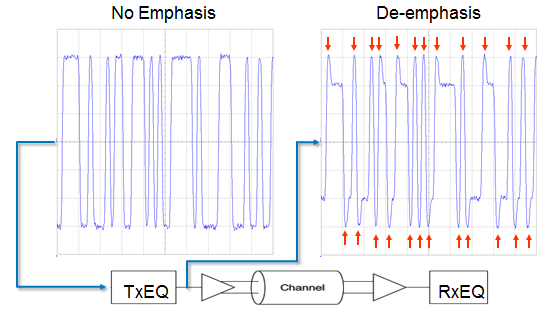
De-emphasis, a key transmit-side equalization technique for PCIe 3.0, boosts high-frequency content
Figure 1: De-emphasis, a key transmit-side equalization
technique for PCIe 3.0, boosts high-frequency content
In an earlier post, we looked at some of the basics of dynamic link equalization for PCIe 3.0, and in particular the reasons why it's not only necessary but mandated by the PCI-SIG for compliance testing. Essentially, the boost in data rates from 5 GT/s in PCIe 2.0 to 8 GT/s in PCIe 3.0 wreaked havoc in terms of signal integrity in the channel. The solution is found in equalization both before (TxEQ) and after (RxEQ) the channel.

06 November 2014

The Hows and Whys of PCIe 3.0 Dynamic Link Equalization
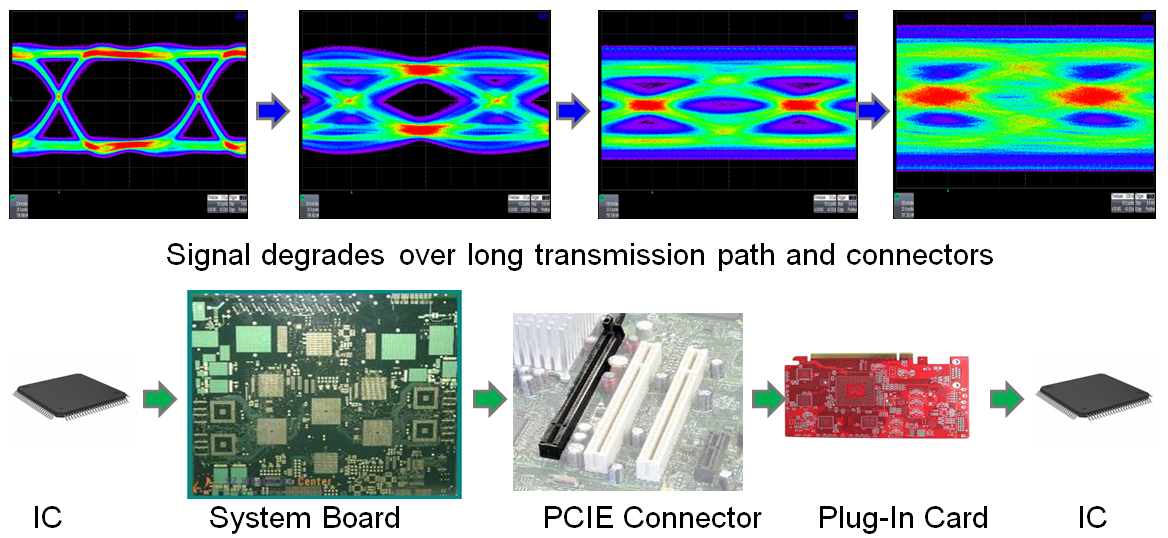
SI problems are the root cause for dynamic link equalization in PCIe 3.0
Figure 1: SI problems are the root cause for
dynamic link equalization in PCIe 3.0
If you're designing a computer peripheral these days, chances are that you'll use the Peripheral Component Interconnect Express (PCIe) protocol for communication between the device and the host system. With the emergence of PCIe, a bunch of older bus standards were kicked to the curb. PCIe itself became the basis for more specialized standards, most notably ExpressCard for laptop expansion cards and SATA Express for storage interfaces.