You need to test, we're here to help.

You need to test, we're here to help.

12 March 2014

Use Trend Functions To Take Power's Pulse

When troubleshooting or debugging almost anything, the first step is usually to check what's going into the device or circuit and what's coming out on the other side. So it is with power supplies, which leads us to power line monitoring and trend functions.

05 March 2014

Measuring Time-Interval Error in Serial Data Waveforms
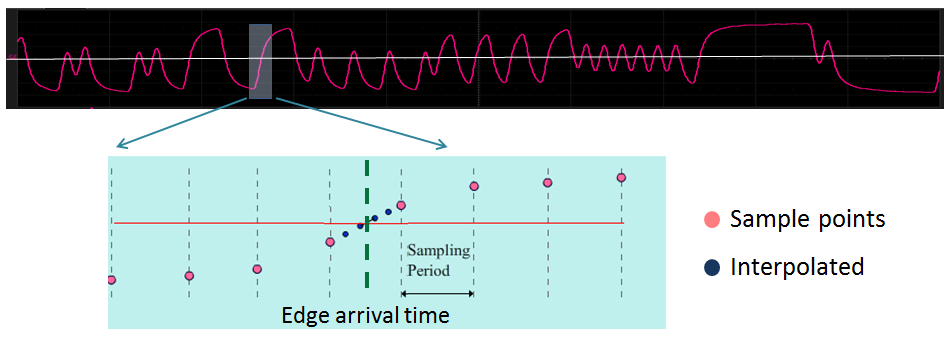
Measured times of arrival
Figure 1: The first step in quantifying jitter is to
determine measured times of arrival for bit transitions
A recent post covered some of the reasons why one might want to measure jitter. In design and debug of serial-data channels, jitter is among the most prevalent causes of unacceptable bit-error rates (BERs). In that earlier post, we looked at the physical phenomenon of jitter and why it wreaks the havoc that it does. In the present installment, we will look in broad terms at how jitter is measured and quantified.

26 February 2014

Understanding Probe Calibration Methods

If there's a topic concerning probes that causes confusion, questions, and misunderstandings, it's loading. It would be a much simpler world if attaching a probe to a circuit under test had no effect on either the signal being measured or the device the probe is connected to. Unfortunately, the world isn't quite so simple.

19 February 2014

Making Sense of Probe Terminology


probe is a critical element in getting signals from the device
As oscilloscope users, we know that the probe is a critical element in getting signals from the device under test into the instrument. The ideal probe would have perfectly flat magnitude response and perfectly linear phase response across its entire frequency range. Unfortunately, that probe, though striven for by all oscilloscope manufacturers, does not exist.

05 February 2014

Why Should You Measure Jitter?

Typical channel with jitter sources
Figure 1: Designing a serial-data channel with first-pass
success means analysis and mitigation of jitter sources
As mentioned in an earlier post on some basics of jitter, the bane of serial-link design is a signal that doesn't arrive at its destination when it should, whether early or late. The goal of serial-link design and implementation is to transmit data with as few bit errors as possible. Thus, analyzing jitter is a key element of achieving first-pass design success.

29 January 2014

Tips and Tricks: Stabilizing a Waveform Trace

One initial challenge to oscilloscope users is achieving a stable display of an input waveform. In almost all cases, the Auto Setup button on Teledyne LeCroy oscilloscopes (and most other modern instruments) will automatically set the oscilloscope's triggering system to get that jumpy trace to settle down.

22 January 2014

The Components of Total Jitter

Figure 1: An overview of the jitter hierarchy, or "jitter tree," showing the various elements that make up total jitter
Figure 1: An overview of the jitter hierarchy,
or "jitter tree," showing the various elements
that make up total jitter
In an earlier post, we began looking at the topic of jitter, a topic of keen interest to anyone working with high-speed serial communications or the components of such a system, including transmitters, receivers, and data channels. To gain an understanding of jitter, an important first step is getting to know a little about the various categories that comprise total jitter.