You need to test, we're here to help.

You need to test, we're here to help.
Showing posts with label probes. Show all posts

15 October 2014

DDR Memory Testing Part IV: Preparing for Testing

For compliance testing, DDR transition density should be as high as possible
Figure 1: For compliance testing,
DDR transition density should
be as high as possible
The first three installments of this series of posts on DDR memory testing are largely concerned with mechanical issues related to probing, use of interposers, and/or damping resistors. Now, we will turn our attention to the preliminaries of DDR testing itself: generating DDR traffic with which to exercise the memory interface, and criteria for a proper read/write burst pattern that will gain good test results.

08 October 2014

DDR Memory Testing Part III: What Not to Do
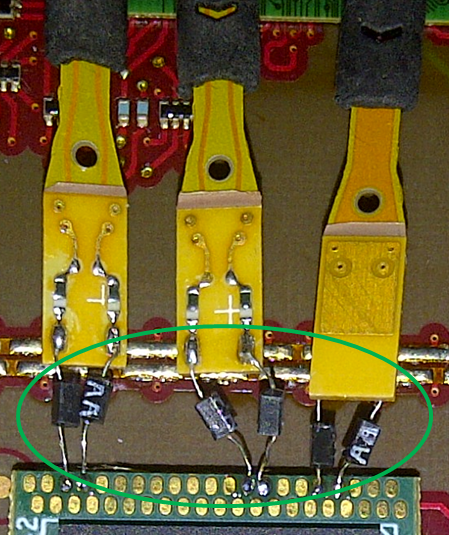
Damping resistors on solder-in probe tips  terminating at chip interposer
Figure 1: Damping resistors on
solder-in probe tips
Testing of dual data-rate memory (DDR) devices and/or modules calls for careful application of some best practices for probing. There will also be cases where the use of chip interposers is called for. Heeding the advice provided in earlier Test Happens posts on this topic will go a long way toward successful probing and testing.

19 February 2014

Making Sense of Probe Terminology


probe is a critical element in getting signals from the device
As oscilloscope users, we know that the probe is a critical element in getting signals from the device under test into the instrument. The ideal probe would have perfectly flat magnitude response and perfectly linear phase response across its entire frequency range. Unfortunately, that probe, though striven for by all oscilloscope manufacturers, does not exist.

12 December 2013

Back to Basics: Probes (Part IV)

An example of differential probes
Figure 1: An example of
differential probes
measuring from test
point to test point.
In three earlier posts on the basics of oscilloscope probes, we've taken a broad overview approach, looked more deeply at passive probes and inductance effects, and most recently, dug into active probes. Next up is differential probes, a different animal entirely from the foregoing types.

13 November 2013

Back to Basics: Probes (Part I)

An example of an active oscilloscope probe
Figure 1: An example of an active
oscilloscope probe 
To speak of an oscilloscope probe is to open a fairly large can of worms. There are many kinds of probes on the market, with differing functions and characteristics (Figure 1). This is the first in a short series of posts on the basics on probes, what the various kinds are used for, and how they might be expected to affect measurements taken with them.

09 July 2013

The Realities of Oscilloscope Probes

Figure 1: Teledyne LeCroy's ZS2500 high-impedance active probe
Looking for a good, albeit very expensive, paperweight? Try using an oscilloscope without probes! Probes are often taken for granted but they are one of the most critical elements of the signal chain in any test scenario.