You need to test, we're here to help.

You need to test, we're here to help.
Showing posts with label active voltage-rail probe. Show all posts

28 November 2022

New 60 V Offset Power Rail Probes Offer the Capability Needed for 48 V Power Integrity Analysis

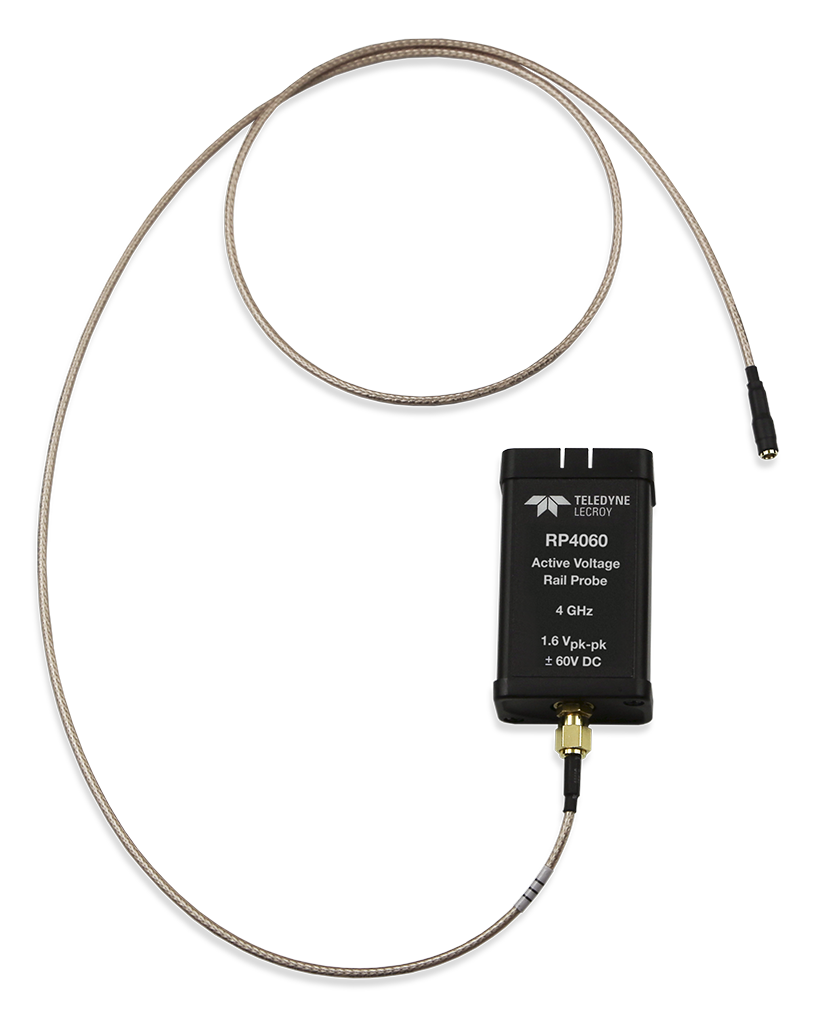
RP4060 Rail Probe
Figure 1. The RP2060 and RP4060
build on the legacy of the RP4030 power
rail probe. The new probes are ideally
suited to working with the new 48 Vdc 
power structures.
In 2016, Teledyne LeCroy first offered the RP4030 Power Rail Probe, which was designed to enable engineers to probe a low-impedance, low-voltage DC power/voltage rail signal without loading the device under test (DUT). It provided ±30 V of probe offset to allow a DC power/voltage rail signal to be displayed in the vertical center of the oscilloscope regardless of the gain (sensitivity) setting.

Recently, we released two, new power rail probes that build on those capabilities—the 2 GHz RP2060 and 4 GHz RP4060. Both probes feature:

  • ±60 V Offset Capability
  • ±800 mV Dynamic Range
  • 50 kΩ DC Input Impedance (for low loading of low-impedance power rails)
  • 1.2:1Attenuation (for low additive noise)
  • MCX-terminated cable with a variety of board connections: 4 GHz*-rated MCX PCB mount;
    4 GHz* solder-in; 3 GHz* coaxial cable to U.FL PCB mount; optional 500 MHz browser
* Bandwidths listed are for the 4 GHz RP4060. Maximum bandwidth when used with RP2060 is 2 GHz.

Why the New Probes?

One driver of the new release is the increase in the number and size of data centers needed to support cloud computing and other data-intensive applications, and the new power architectures they require. The new rail probe is designed to ideally meet the needs of engineers working with power rails rated up to 48 Vdc.

19 July 2021

How to Test Noisy Power Supply Outputs

Figure 1: 3.3 V output of a DC-DC converter. The waveform shows the nominal DC level, ripple and high frequency noise bursts.
Figure 1: 3.3 V output of a DC-DC converter.
The waveform shows the nominal DC level,
ripple and high frequency noise bursts.
Did you ever acquire the output of a power supply with your oscilloscope and find an unexpectedly high level of noise? Did you try adding filter capacitors only to find the noise level was not changed? 

In this post, we'll discuss how the choice of probe affects the noise present in power measurements, as well as how oscilloscope settings such as termination impedance, bandwidth and coupling can be adjusted to lessen noise and improve measurement results.

Figure 1 shows a typical DC-DC converter output measurement. The mean value of the waveform is 3.294 V.  Ripple appears at the switching frequency of 1.2 MHz, and noise in the form of high frequency bursts and baseline thickening is visible throughout.

Waveforms like this can be acquired with a 10:1 high impedance probe, a 1:1 coaxial cable connection, or a 1.2:1 rail probe using either DC or AC coupling, as available.  Figure 2 summarizes how each oscilloscope/probe configuration affects the measurement.

29 August 2018

A Walk-Through of Ground-Bounce Measurements

The trigger pulse from the MCU is one clock cycle in width
Figure 1: The trigger pulse from the
MCU is one clock cycle in width
In earlier posts in this series, we've explained what ground bounce is and how it happens. We have also taken a deeper dive into the use of I/O drivers to implement sense lines that let us better quantify and analyze what kind of ground-bounce hit our system is taking. Now, let's look at a detailed example of how to measure and diagnose ground bounce.

16 April 2018

Anatomy of an IoT Device

IoTs include SOCs, DDR, DPM ICs, wireless, and MCUs
Figure 1: IoTs include SOCs, DDR,
DPM ICs, wireless, and MCUs
There's already more Internet of Things (IoT) devices deployed than there are humans on Earth. That gap will increase radically in coming years, and the explosion in IoT devices means a commensurate explosion in the need for debugging tools. So what's in an IoT device to debug, anyway?