You need to test, we're here to help.
Showing posts with label insertion loss. Show all posts
27 May 2020
Reading S-parameters: Sharp Dips
Where do you see resonant coupling? Resonant structures can include coupling to an interconnect that is floating and not terminated. The structure does not have to be a uniform transmission line, it can also be a cavity made up of two or more adjacent plates as shown in Figure 1. Commonly, when a signal goes through a cavity and we hit the resonances of the cavity, it absorbs energy and results in narrow dips in the S-parameters.
18 May 2020
Reading S-parameters: Broad Dips
![]() |
| Figure 1. Quarter wave stubs exhibit resonance which impacts S21 as broad dips. The resonant frequency can be computed based on the characteristics of the transmission lines and its length. |
Not surprisingly, the open stub is a discontinuity. What's going to happen? At the open, it's going to reflect and head back. At the junction, it's going to branch. Some of it's going to go back toward the source and some of it's going to go forward toward the receiver.
11 May 2020
Reading S-parameters: Monotonic Drop Offs
![]() |
| Figure 1. As a signal propagates, the amplitude drops off exponentially with distance due to signal losses. |
V_Out is shown as V_In times a decaying exponential. (Note that attenuation is usually described using base 10 rather than base e).
04 May 2020
Reading S-parameters: Ripples
![]() |
| Figure 1. Ripple patterns commonly seen in S11 and S21. |
16 April 2020
Six Ways Not to be Confused by S-parameters (Part II)
In Part I, we discussed three causes of confusion when working with S-parameters and what you can do to avoid them. In this post, we’ll discuss three more ways not to be confused by S-parameters.
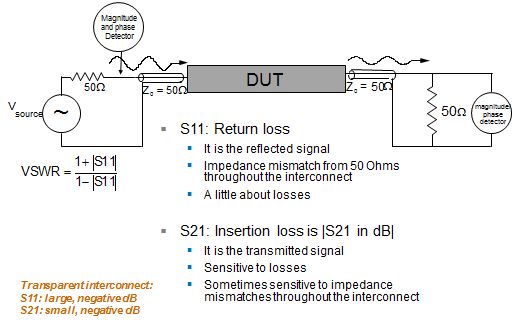
There are two S-parameters of interest in a 2-port device. The first is the reflection coefficient, S11, that measures the ratio of the reflection from Port 1 to the drive signal at that port. The second is the transmission coefficient, S21, that is the ratio of the output of Port 2 to the drive signal into Port 1. Confusion arises because historical measurements of return loss and insertion loss are often used interchangeably with reflection coefficient and transmission coefficient, respectively.
4. Know the difference between return loss and reflection coefficient
There are two S-parameters of interest in a 2-port device. The first is the reflection coefficient, S11, that measures the ratio of the reflection from Port 1 to the drive signal at that port. The second is the transmission coefficient, S21, that is the ratio of the output of Port 2 to the drive signal into Port 1. Confusion arises because historical measurements of return loss and insertion loss are often used interchangeably with reflection coefficient and transmission coefficient, respectively.
13 April 2020
Six Ways Not to be Confused by S-parameters (Part I)
S-parameters describe the electrical properties of electronic interconnects, which can include connectors, printed circuit traces and vias, cables, and oscilloscope probes. Given that instruments such as Teledyne LeCroy’s WavePulser 40iX make measuring S-parameters relatively simple, there are still some aspects of S-parameters that can cause confusion, especially to new users. Here are six things you can do to avoid confusion when working with S-parameters.
1. Know where the fixture ends and the DUT begins
10 July 2018
Serial-Data Channel Emulation and S Parameters
![]() |
| Figure 1: Higher data rates + "same old" channel media = degraded signal quality at receiver |
12 June 2018
How Much Transmission-Line Loss is Too Much?
![]() |
| Figure 1: This plot represents the differential insertion-loss profile for a 20" FR-4 microstrip trace |
17 December 2014
What S-parameters Reveal About Interconnects (Part III)
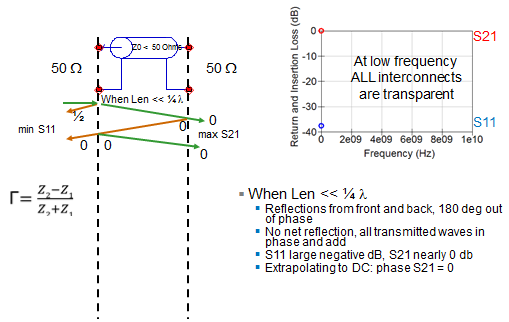
| Figure 1: How ripple is introduced into S11 and S21 |
09 December 2014
What S-parameters Reveal About Interconnects (Part II)
| Figure 1: Measuring S-parameters of a two-port interconnect |
Subscribe to:
Posts (Atom)