You need to test, we're here to help.

You need to test, we're here to help.
Showing posts with label variable frequency drive. Show all posts

15 March 2018

An Example of Three-Phase Power Measurements

Screen capture of a 10-s acquisition of AC input and PWM output of a 480-V motor drive
Figure 1: Screen capture of a 10-s acquisition of AC input
and PWM output of a 480-V motor drive
To follow up on our last post on three-phase power calculations, and to wrap up this series of posts on the fundamentals of power, we'll walk through an example of a set of three-phase power measurements. We'll base our discussion on a single screen capture of measurements taken on a 480-V motor drive with 480-V AC input and 480-V maximum drive output. For this example, we used a Teledyne LeCroy Motor Drive Analyzer.

05 June 2015

Testing Challenges in Motor Drive Systems (Part III)

Figure 1: An example of PWM for a single power semiconductor
Figure 1: An example of PWM for
a single power semiconductor
As noted in an earlier post, variable-frequency motor drives (VFDs) display a good amount of variation in terms of architectures and topologies. Another differentiator between VFDs is their application of pulse-width modulation (PWM) techniques.

15 April 2015

Testing Challenges in Motor Drive Systems (Part II)
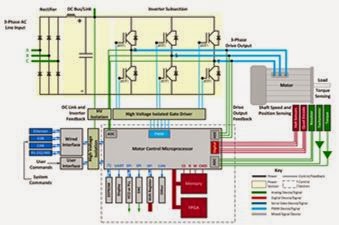
Yhe complete design and debug challenge posed by a variable-frequency motor drive
Figure 1: This image depicts the complete design and
debug challenge posed by a variable-frequency motor drive
In our first post on motor drive systems, we broke down the major subsystems in a "generic" variable frequency drive (VFD) and discussed some of the test requirements in those subsystems (Figure 1). Next, let's have a look at some of the variations in real-world VFDs in terms of architectures and topologies.

07 April 2015

Testing Challenges in Motor Drive Systems

The power section of a motor drive system requires measurements of line input, PWM output, and efficiencies
Figure 1: The power section of a motor drive system requires
measurements of line input, PWM output, and efficiencies
Motors are everywhere in our world, and nowhere more so than in  our vehicles. For example, when's the last time you had to crank a car window up and down to pay a highway toll? Or, for that matter, when did you last manually adjust the seat position or rear-view mirror angles? These aspects of vehicles are all typically motorized these days.