You need to test, we're here to help.

You need to test, we're here to help.
Showing posts with label active probe. Show all posts

05 September 2022

Choosing a High-voltage Oscilloscope Probe for SiC/GaN Power Semiconductor Device Measurements

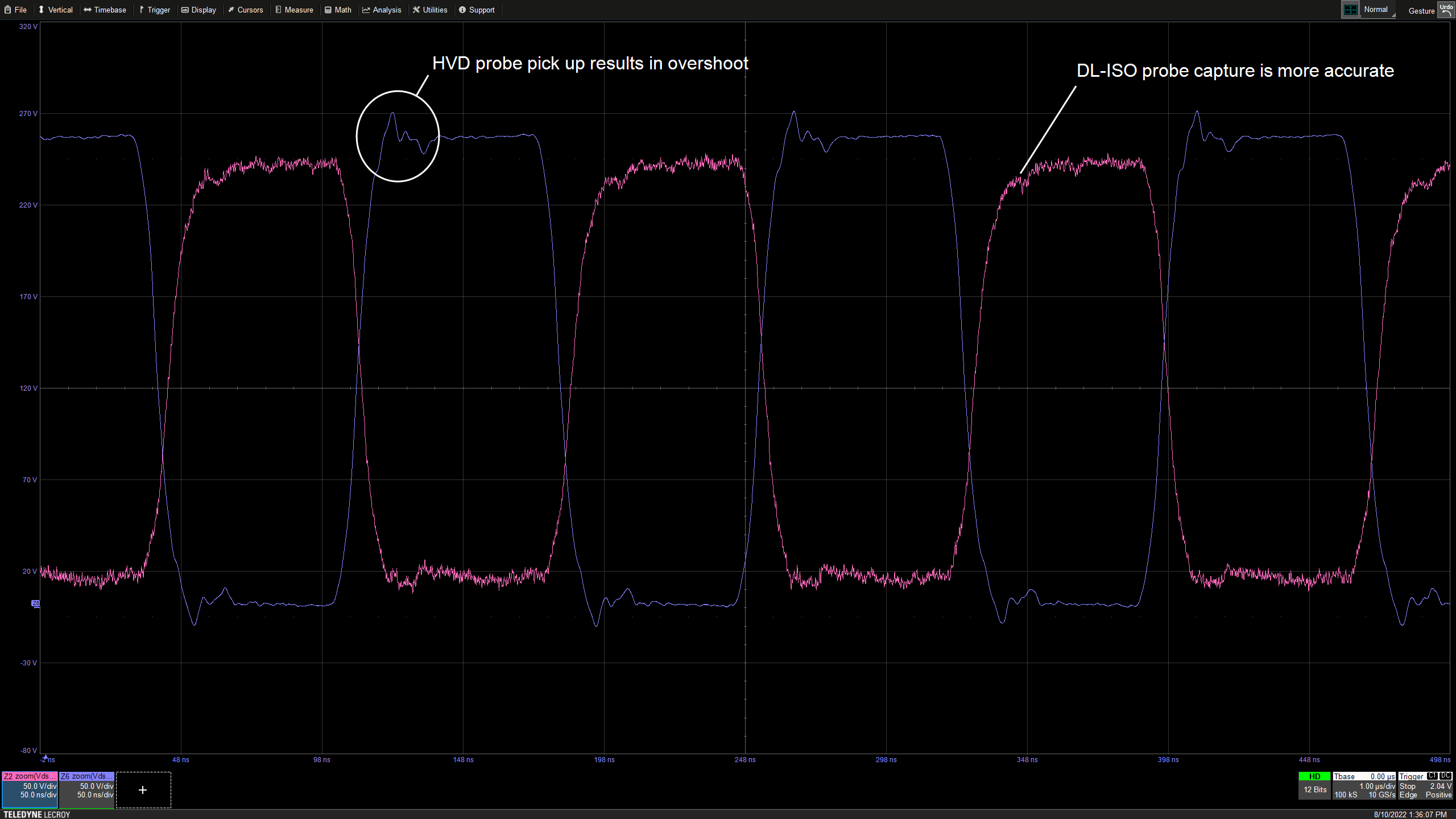
Wide-bandgap (GaN) power semiconductor device waveforms captured using two, different probe topologies
Figure 1: Wide-bandgap (GaN) power semiconductor device
waveforms captured using two, different probe topologies.
Click on any image to expand.
In our last post, we introduced you to a new tool on the Teledyne LeCroy website: The High-voltage Probe Selection Guide. To demonstrate the benefits of the guide, let’s explore further what must be considered when choosing an HV oscilloscope probe for power semiconductor device measurements.

Why are power semiconductor device measurements challenging?

29 August 2022

How to Choose the Best High-voltage Oscilloscope Probe in 5 Minutes

High-voltage Probe Selection Guide color codes better or worse probe selections.
Figure 1: The High-voltage Probe Selection Guide
color codes better or worse probe selections based on
your answers to three, simple questions.
Click any image to enlarge.
Probing high-voltage (HV) circuits for analysis with an oscilloscope presents unique challenges due to the potential for injury or equipment damage, as well as the demands of the materials used in HV semiconductors. HV floating measurements are extremely dangerous and difficult to make. Conventional passive probes are not the answer, but isolated and high-voltage differential probes are options. Yet, with many possible choices in these categories, how can you decide which is actually the best HV oscilloscope probe for your application?

Teledyne LeCroy offers this new, easy way to help you select a high-voltage oscilloscope probe based on your specific application—the High-voltage Probe Selection Guide—available on the Teledyne LeCroy website at: teledynelecroy.com/powerprobes

16 April 2018

Anatomy of an IoT Device

IoTs include SOCs, DDR, DPM ICs, wireless, and MCUs
Figure 1: IoTs include SOCs, DDR,
DPM ICs, wireless, and MCUs
There's already more Internet of Things (IoT) devices deployed than there are humans on Earth. That gap will increase radically in coming years, and the explosion in IoT devices means a commensurate explosion in the need for debugging tools. So what's in an IoT device to debug, anyway?

22 January 2018

Power-Rail Noise: Small Signal, Big DC Offset

Your scope's vertical adjust has its limits
Figure 1: Your
scope's vertical
adjust has its
limits
We've been working through the various challenges in making power-rail noise measurements. One of those challenges is RF pickup that can often swamp the noise signal, and the way around that is to ensure a coaxial connection from the oscilloscope's input down to the power rail itself. We want a high signal-to-noise ratio (SNR), so we're better off with a 1X probe than with a 10X attenuating probe. We want high bandwidth, so we want a 50-Ω termination at the oscilloscope input.

02 November 2015

Video: The Many Varieties of Oscilloscope Probes

Got a minute (OK, a minute and a half)? Take a look at this quick tutorial video that takes you through the four basic types of probes and what they're used for:


If this little thumbnail sketch whetted your appetite for more info on oscilloscope probes, we've got you covered with a series of popular blog posts on the topic:


04 December 2013

Back to Basics: Probes (Part III)

Active oscilloscope probes
Figure 1: Active oscilloscope probes
sport high resistance and low
capacitance at their tips, but
terminate into a scope's 50Ω input.
In the first two installments of this series on probe basics, we examined some broad probe categories (Part I) and some of the issues that come with probe inductance (Part II). In the present installment, we'll delve a bit deeper into the topic of active probes. We'll also discuss when it's best to use passive probes and when to use active types.

13 November 2013

Back to Basics: Probes (Part I)

An example of an active oscilloscope probe
Figure 1: An example of an active
oscilloscope probe 
To speak of an oscilloscope probe is to open a fairly large can of worms. There are many kinds of probes on the market, with differing functions and characteristics (Figure 1). This is the first in a short series of posts on the basics on probes, what the various kinds are used for, and how they might be expected to affect measurements taken with them.